Please wait while we load the content.
Est. 1992 · University status since 2005
Producing qualified pharmacists for safe, effective health care and quality pharmaceutical products for the whole populace.
Pharmacy training in Myanmar began in 1964 with the Department of Pharmacy of the Institute of Paramedical Sciences, in the compound of Yangon General Hospital.
The Institute of Pharmacy, Yangon was established in January 1992 and upgraded the diploma to the Bachelor of Pharmacy (B.Pharm.). It moved to its present 19.958-acre campus on Waibargi Road, North Okkalapa in May 2001 and began the Master of Pharmacy course in 2003.
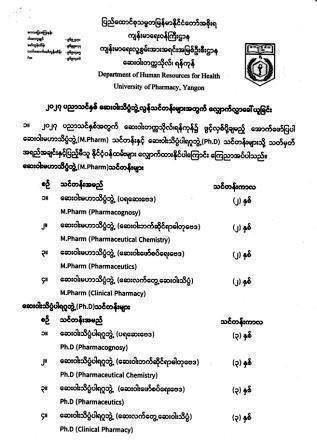
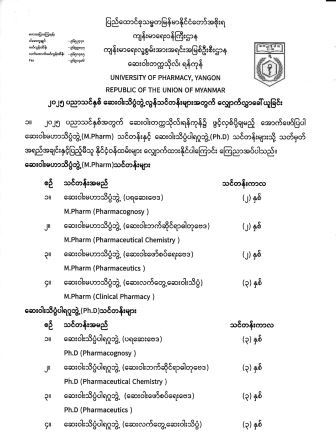
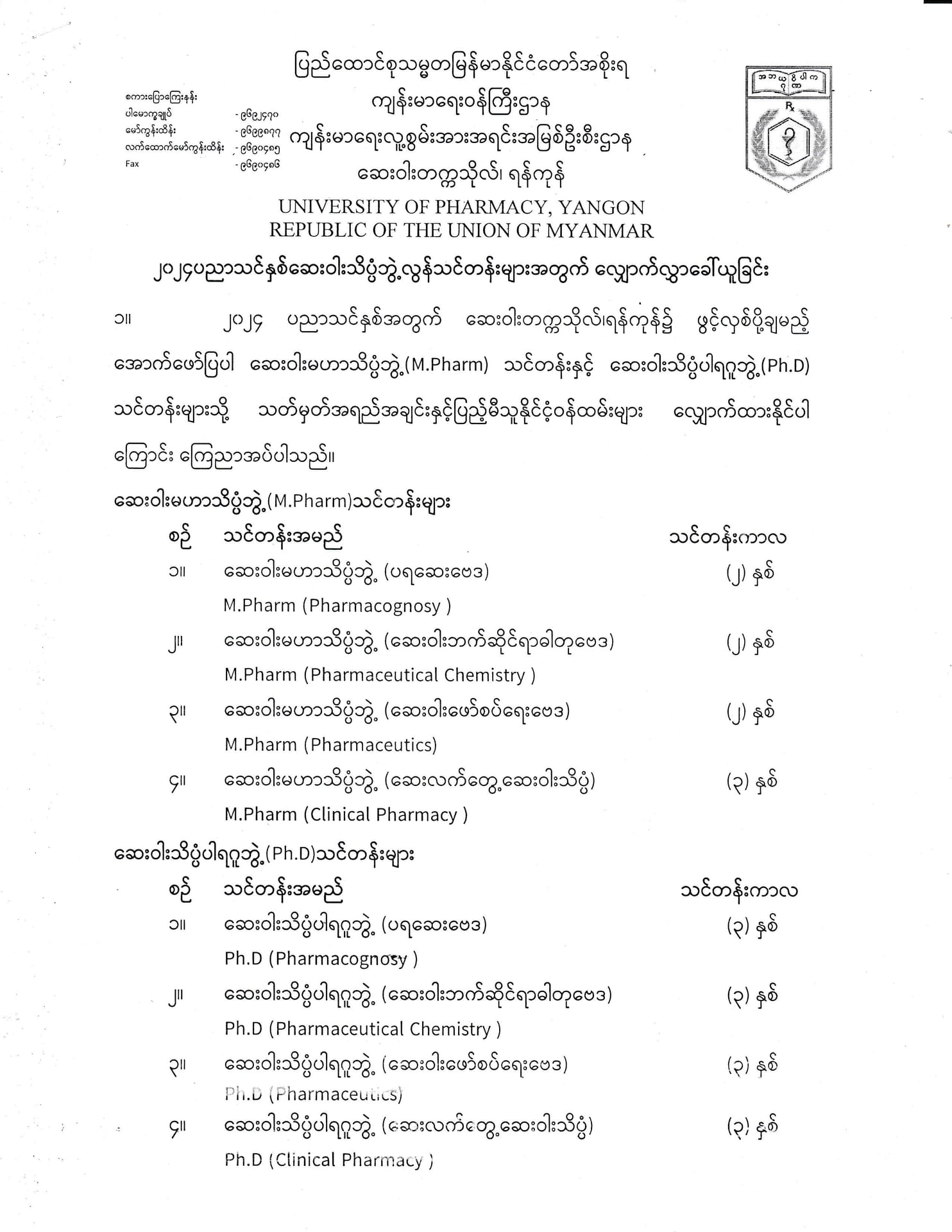
Upgraded to university status in 2005, the University of Pharmacy, Yangon started its Ph.D. programs (Pharmacognosy, Pharmaceutical Chemistry, Pharmaceutics and Clinical Pharmacy) in 2014.
Office of the Rector
 Rector
M.B.,B.S. (Ygn), M.Med.Sc. (Pharmacology), Ph.D. (Pharmacology), Dip.Med.Ed., DCME
Welcome! You are welcome to see the rounded picture of the University of Pharmacy, Yangon and observe it in this website, and enjoy learning here. It is a great pleasure and an honor for me to present the concrete, concise, and update information about our University.
Since 1992, the University has been producing proficient graduates while upgrading herself with the unanimous efforts of administrative and academic staff hand in hand under the leadership of successive devoted rectors. I take great pride in serving this University as the present rector.
To attain qualified pharmacists for the provision of safe and effective health care and quality pharmaceutical products for the whole populace, keeping abreast with developed countries in the region.
To acquire knowledge of the health care delivery system.
To perform professional tasks and responsibilities in health teams by applying pharmaceutical-care knowledge in community and hospitals.
A foundation of pharmaceutical technology and services for teaching, hospitals, community pharmacy, drug information, administration, industry and research.
Self-directed, lifelong learning so pharmacists respond to changing health needs and advances in pharmaceutical knowledge and technology.
Notices